

في صباغة المنسوجات و الانتهاء production, many factories will focus on dyes, المساعدون, temperature and process parameters, but easily ignore a factor that often affects the production stability: water quality and metal ions in water.
Especial in المعالجة المسبقة, bleaching, dyeing and finishing process, if metal ions such as calcium, magnesium and iron are not effectively controlled, they may interact with dyes, auxiliaries or process systems, thereby affecting the entire production process.
For dyeing mills, such problems sometimes do not directly lead to obvious equipment fault, but rather appear in a more concealed way:
- Stability of dyeing bath is decreased and the process repeatability is influenced.
- There will easily occur color difference or shade changing in dyeing process.
- Whiteness of white or light-colored fabrics is unstable.
- Bleaching effect is influenced.
- The using effect of dyes and auxiliaries fluctuates.
- Engineer needs to repeatedly adjust formula and process parameter.
Therefore, in dyeing and finishing production, عامل العزل is not a simple ancillary product, but an important auxiliary used to control the interference of metal ions and stabilize the dyeing and finishing process system.
Why Is Sequestering Agent Needed in Dyeing and Finishing Process?
Production water supply for dyeing mills is not completely pure.
According to the water sources and water supply conditions in different areas, in the production water supply, there may be metal ions such as calcium, magnesium and iron of different degrees.
After these metal ions enter the dyeing and finishing process, they may interact with other chemical substances in the system.
Especially in pretreatment, التبييض and dyeing process, when the concentration of metal ions is high or the process conditions change, it may increase the difficulty to control production.
Therefore, one of the main functions of sequestering agent is to form a stable complex system with metal ions to reduce the interference of these metal ions on dyeing and finishing process.
For engineers in dyeing mills, when choosing a sequestering agent, it needs to importantly pay attention to:
- The ability to control metal ions such as calcium, magnesium and iron.
- The stability in actual process condition.
- The compatibility with other dyeing and finishing auxiliaries.
- The product form and application method.
- The applicability to different process system.
Among, chelating ability is one of the important indicators for evaluating products, but it is not the only factor to be considered.
For Different Water Quality, Need to Choose Different Sequestering Agent
The production water conditions, equipment and process systems in different dyeing mills are different, so the requirements for sequestering agents are not exactly the same.
For example, some factories pay more attention to the convenience of using liquid products and they hope that the product can enter the current production system rapidly. But some factories concern more about the storage and using method of powder products.
At the same time, different production systems have different requirements for chelating ability.
Therefore, sequestering agent is not that “one item solves all problems.”
In the actual selection process, the more reasonable approach is comprehensively judged according to:
Water quality → Types of metal ions → Process requirements → Product form → Chelating ability
For purchasing staff, this choosing method is more reasonable than simply comparing the purchase price per kilogram.
What Should Dyeing Mills Pay Attention to When Choosing Sequestering Agents?
Firstly, water quality of production water supply
Water quality is the first factor to be considered when choosing a sequestering agent.
If the water used in the factory has a high hardness, or if there are significant changes in water quality between different seasons and water sources, it is necessary to pay close attention to the product’s control ability over metal ions such as calcium and magnesium.
Thus, before choosing products, dyeing mills can make tests in combination with the actual production water supply.
Secondly, the categories and content of metal ions
Different metal ions may have different influences on dyeing and finishing process.
Therefore, when conditions permit, knowing about the types and contents of the main metal ions in production water can help engineers further determine the direction of choosing a sequestering agent.
Especially in products with high requirements for whiteness, bleaching effect and color stability, the control of metal ions deserves more attention.
Thirdly, the chelating ability of product
Chelating ability is an important indicator to evaluate the sequestering agent.
But the testing methods and indicators of different products may be different. Therefore, when comparing different products, one cannot merely look at a single figure. It is also necessary to conduct tests according to actual application conditions.
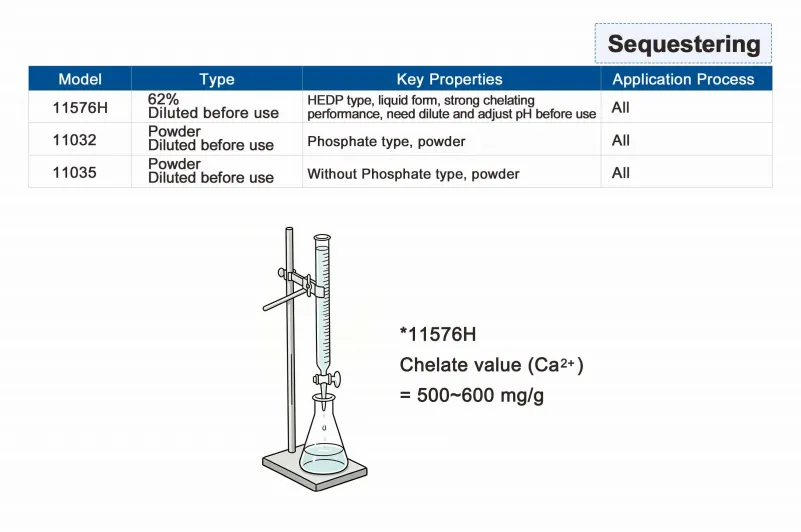
For example, the information of BLUELAKECHEM 11576H shows that its chelating value on Ca²⁺ is 500~600 mg/g, which can be used as a reference index for evaluating the chelating ability of the product.
Fourthly, product form and using method
Sequestering agent can be liquid, also powder.
Liquid products are usually more convenient to measure and add, but some products need to be diluted and adjusted pH before used.
Powder products should be selected according to factory’s current conditions of dissolving, measuring and feeding.
Therefore, the product form is also the factor to be considered by purchasing staff and engineer.
Fifthly, compatibility with existing dyeing and finishing formula
The dyeing mills’ production formula generally includes multiple chemical auxiliaries.
Therefore, after adding عامل العزل, it needs to observe its compatibility with the existing المواد المساعدة قبل المعالجة, مواد مساعدة في الصباغة and other functional auxiliaries.
Finally, it is still suggested to make sample test or site test according to actual production conditions.
BLUELAKECHEM Sequestering Agent Series: Select Products Based on Different Process Requirements
At present, BLUELAKECHEM Sequestering Agent Series include three products, as 11576H, 11032 and 11035.
According to the product information, these three products differ in terms of product form, main types and product features:
- 11576H: liquid with 62% content. Should be diluted and adjusted pH before used.
- 11032: powder. Contains phosphate.
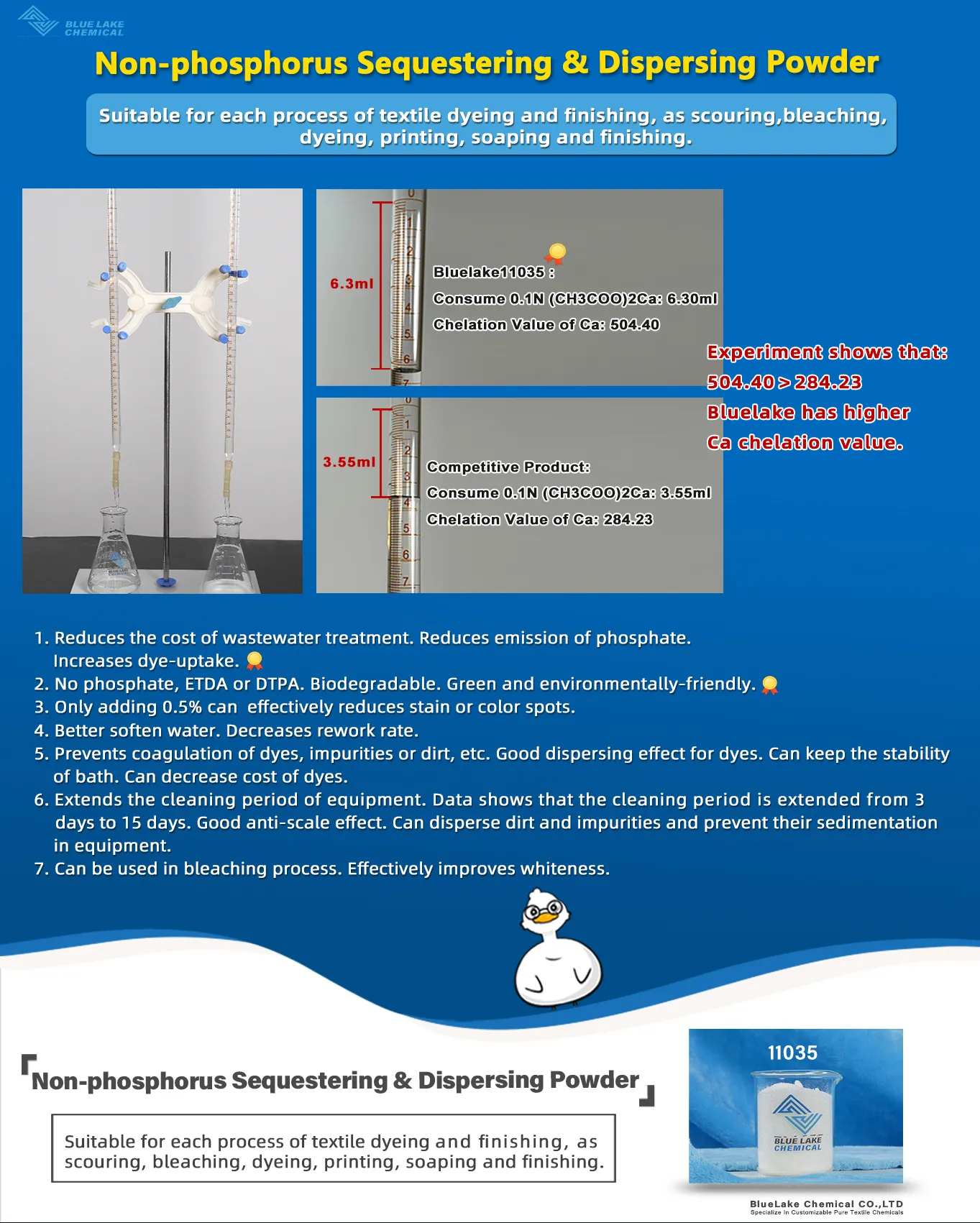
- 11035: powder. No phosphate.
These three products can be applied in different dyeing and finishing process. So when choosing a product, it needs to make test according to the equipment, formula and specific production in the factory.
How to Choose a Suitable Sequestering Agent According to the Dyeing Mill’s Requirement?
For purchasing staff and dyeing mill engineer, they can first conduct a preliminary screening based on product form, product type and production requirements:
| Item No. | Product form | Product Type/الميزات | What to Pay Close Attention When Choose |
| 11576H | Liquid with 62% content | HFD, Stronger chelating performance, chelating value of Ca²⁺is500–600 mg/g. | Liquid product system. Control ability on metal ions. Condition of diluting and adjusting pH. |
| 11032 | Powder | Contains phosphate. | Powder product system. Existing feeding condition and process requirement. |
| 11035 | Powder | No phosphate. | No phosphate. Powder product system. Process requirement. |
In actual production, it is suggested that dyeing mills make comparison test based on water quality, metal ion content, fabric type, process conditions and the existing auxiliary system.
It is particularly important to note that the production water supply and process conditions vary among different factories. Even if they use the same item product, the optimal dosage and using method may also be different.
Therefore, the final product selection should be based on the actual production test results.
11576H: Liquid Sequestering Agent with High Chelating Ability
11576H is a liquid type sequestering agent with 62% content. The product information shows that it belongs to HFDP type, which has strong chelating performance.
According to product test result, the chelating value of 11576H on Ca²⁺ is 500~600 mg/g.
This data can serve as an important reference for evaluating its chelating ability on calcium ion.
Comparing with powder product, 11576H is liquid form. In actual production, it needs to be diluted according to using requirement and also adjusted pH before used.
Therefore, for dyeing mills that hope to adopt liquid product and pay attention to strong control ability on metal ions, they can test 11576H based on their own processes.
It should be noted that the product information clearly states that 11576H needs to be diluted and adjusted pH before used. The specific using conditions should be determined according to actual process.

11032: Phosphate Type Sequestering Powder
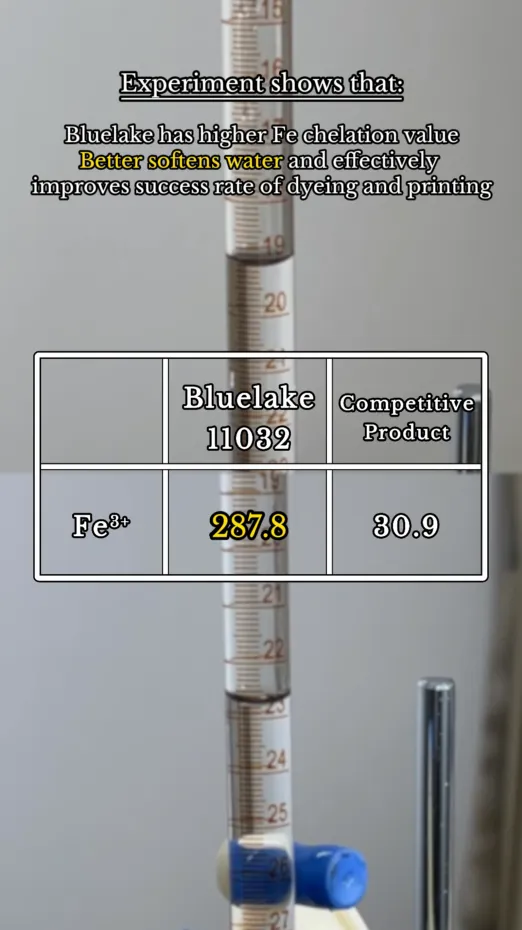
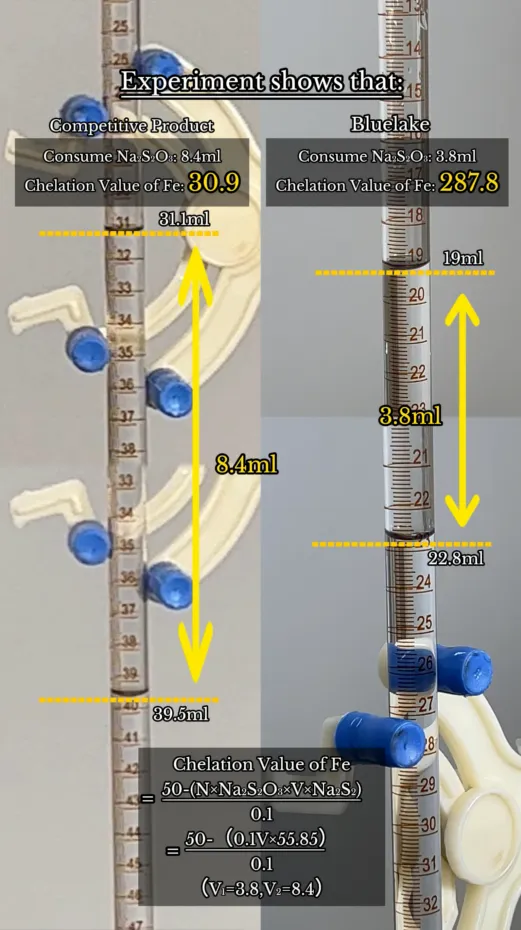
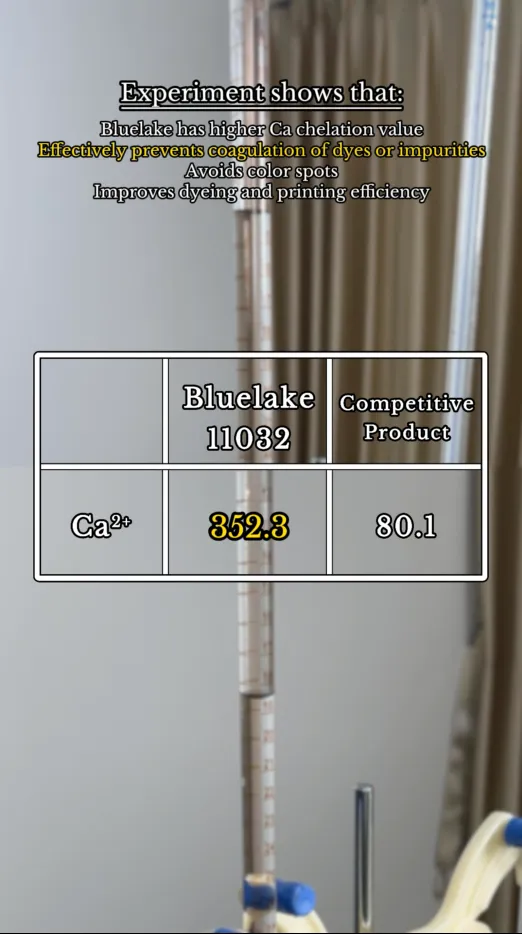
11032 is sequestering powder. Product information shows that is phosphate type.
Dyeing mills adopting powder auxiliary system can make test on 11032 according to existing production equipment, feeding method and process requirement.
Comparing with liquid product, powder products have different characteristics in terms of storage, transportation and production feeding methods. Therefore, purchasing staff needs to not only pay attention to chelating effect, but also consider the current production conditions in the factory when choosing the product.
If the factory has already established a dissolving and feeding system for powder auxiliaries, 11032 can be considered as one of the options.
11035: None-phosphate Sequestering Powder
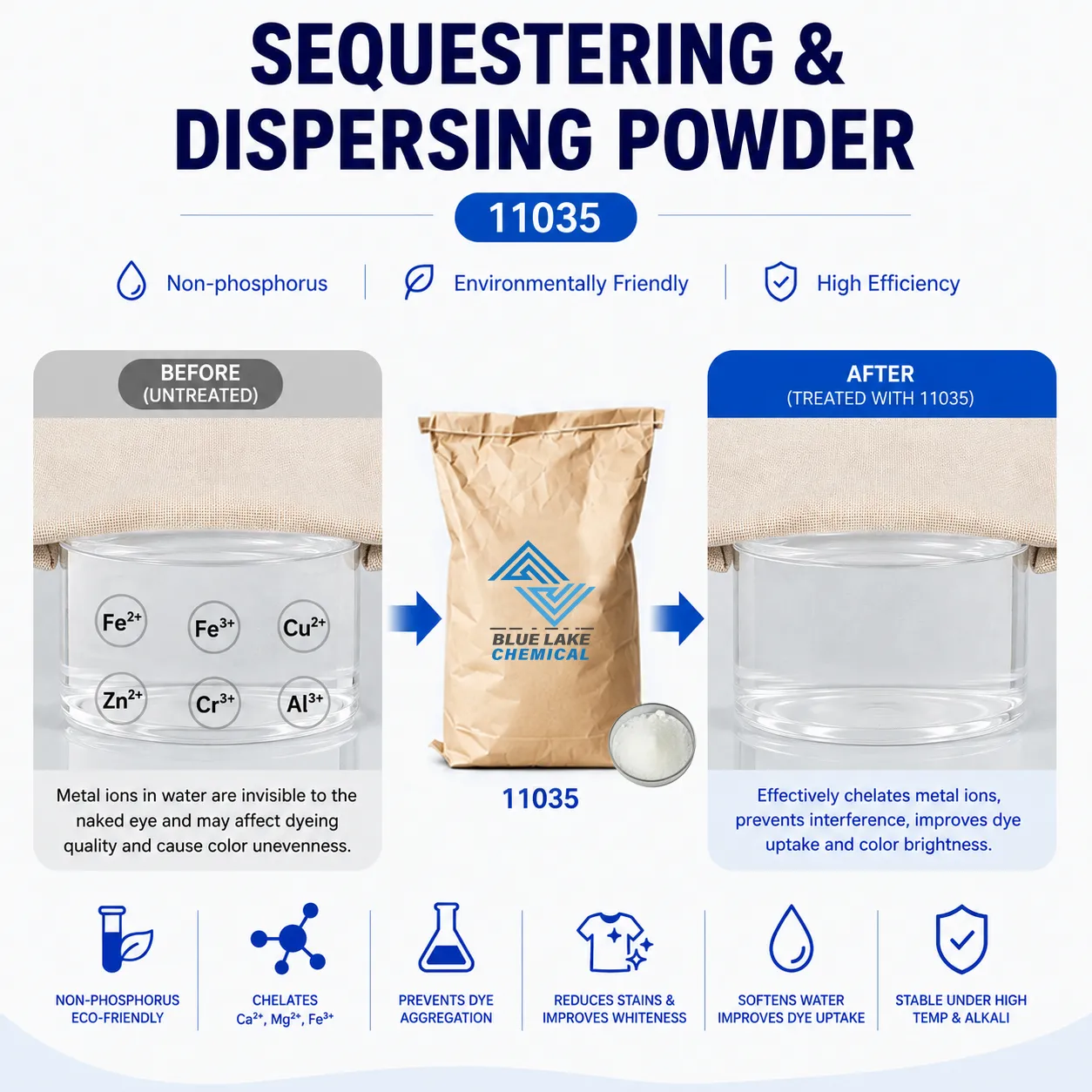
11035 is also powder product. But it is different from 11032. Its main characteristic is no phosphate.
This difference has practical reference value for some dyeing mills that have specific requirements for the formula system or environmental protection.
For production systems that wish to use sequestering powder and also need to avoid phosphate-type products, they can further test 11035.
Therefore, although both 11032 and 11035 are powder, there are differences in product types. In actual selection, it needs to judge it according to formula system and production requirement of the factory.
Sequestering agent does not solve water quality problem alone, but help stabilize the entire dyeing and finishing system
For dyeing mills, the value of sequestering agent is not just “deal with hard water”.
From pretreatment to bleaching, as well as dyeing, metal ions may influence each different process. Thus, reasonably controlling the metal ions can help dyeing mills to reduce the process uncertainty caused by fluctuations in water quality.
For different positions, their focuses will be different.
For dyeing mills bosses:
They importantly pay attention to production stability, batch consistency and quality risk caused by water quality fluctuation.
For purchasing staff:
They pay attention to product form, product type, actual dosage and the match degree with existing process, not just simply compare purchasing price.
For dyeing mill engineers:
They need to importantly pay attention to chelating ability, water quality, content of metal ions, bath stability and compatibility with other auxiliaries.
Finally, whether the sequestering agent is suitable for a production system, it still needs to be tested in actual water quality, fabric and process condition.
BLUELAKECHEM: Provide Sequestering Agent Solution for Global Textile Enterprises
بلويلاكشيم focuses on the research and development, production and application of textile chemical auxiliaries, providing textile dyeing and finishing auxiliaries and application support for overseas dyeing mills, textile manufacturing enterprises, textile chemical traders and distributors.
In the field of pretreatment, dyeing and finishing auxiliaries, BLUELAKECHEM has established a product system including عامل العزل, scouring agent, عامل ترطيب, عامل التشتيت وأخرى المواد المساعدة قبل المعالجة. We can provide corresponding product according to different water quality, fabric type and production process.
At present, our sequestering agents include 11576H, 11032 and 11035, including different product forms, as liquid and powder and providing different product options.
If there are problems such as high water hardness, metal ion interference, unstable whiteness, batch differences in dyeing or insufficient process stability in your production process, welcome to test BLUELAKECHEM sequestering agent series according to the actual production conditions.
BLUELAKECHEM can provide sample test and product application support according to customer’s water quality condition, fabric type, production equipment and specific process requirement. We can help dyeing mills to determine the more suitable product and application by actual test.