

In the tingimento e acabamento process of cotton fabrics, branqueamento e biological polishing is the important link to affect the final appearance, whiteness and surface quality.
For dyeing mills, pretreatment is not to simply finish “bleaching”. After pré-tratamento, the cotton fabric still needs to meet the requirements of subsequent dyeing, printing and the final product for whiteness, surface smoothness and quality stability.
If the bleaching process is not well controlled or the biological polishing process is not properly selected, some common problems may occur during the production process:
- After bleaching, whiteness is not enough and base color of fabric is not clean enough.
- There are differences in whiteness and color shade among different batches.
- The oxidation system control during the bleaching process is unstable.
- The residual oxidizing agent after bleaching affects the subsequent dyeing.
- There are too many fuzz on the surface of cotton fabric and the fabric surface is not smooth enough.
- Biological polishing effect is not stable, which influences the final appearance of fabric.
- The storage, transportation and using conditions of enzyme auxiliaries increase the difficulty of production management.
- Bleaching, deoxygenizing and biological polishing required to be processed separately, increasing the pressure on process management.
Therefore, for engineers and purchasing staff in dyeing mills, when choosing branqueamento e bio-polishing auxiliaries, it is necessary to make targeted selections based on the final requirements of fabric and the actual production process, rather than focusing only on one single function of a certain product.
Why Does The Bleaching of Cotton Fabrics Require Stable Process?
In pretreatment process of cotton fabrics, bleaching is needed to improve the base color and whiteness of fabrics, so as to create a more stable foundation for subsequent dyeing, printing and other processing.
In bleaching process, hydrogen peroxide is one of the common oxidation bleaching systems.
But in the bleaching process, it is not the more hydrogen peroxide, the better.
If the oxidizing process in the bleaching system is not properly controlled, it may affect the quality of fabric and the stability of production. Therefore, dyeing mills need to adopt an appropriate bleaching stabilization system to make the bleaching process more controllable.
For engineers, in bleaching process, it needs to pay more attention to:
- the stability of bleaching system.
- the effective utilization of hydrogen peroxide in the process.
- the final whiteness of fabrics.
- the consistency of the base color after bleaching.
- the connection with subsequent dyeing process.
Thus, bleaching stabilizer plays a significant role in the entire pretreatment system.
Why Is It Necessary to Pay Attention to Residual Oxidizing Agent after Bleaching Is Completed?
After bleaching is completed, it does not mean that the pretreatment is totally finished.
If there is residual oxidizing agent in the fabric after bleaching and is not effectively treated, it may affect the subsequent dyeing process.
Especially in the continuous production process of bleaching and dyeing, the control of residual oxidizing agent is one of the issues that engineers need to pay attention to.
Therefore, some dyeing mills will add deoxygenizing treatment after bleaching, using peroxides to remove residual oxidizing agent from the product, creating more suitable process conditions for subsequent dyeing.
From the perspective of production management, bleaching stabilizer and deoxidizing agent are to solve problems at two different stages:
During the bleaching process, it is to pay attention to the stability of the system. And after bleaching is completed, it is to pay attention to the residual oxidizing agent.
This is also why dyeing mills need to consider different types of auxiliaries according to the actual process when they establish a complete pretreatment system for bleaching.
Whiteness Is Not Just about “The Whiter, The Better”. It Also Needs to Take into Account the Final Color Shade
For cotton fabrics, the whiteness after bleaching directly affects the visual effect of sequent dyeing and printing.
Especially for white and light colored fabrics and products with higher requirements for base color, if the base color of fabrics themselves is not clean enough, the visual appearance of final products may be affected.
For some products, natural whiteness may already meet the requirement. For products with higher requirements for visual whiteness, the optical whitening agents can be further considered to improve the whiteness of fabric.
Therefore, the improvement of whiteness is not a fixed production standard but should be determined by combining with:
Type of fabric → Customer’s requirement → Final color → Standard of whiteness
Make a choice.
Why Is Biological Polishing Attracting More and More Attention from Dyeing Mills?
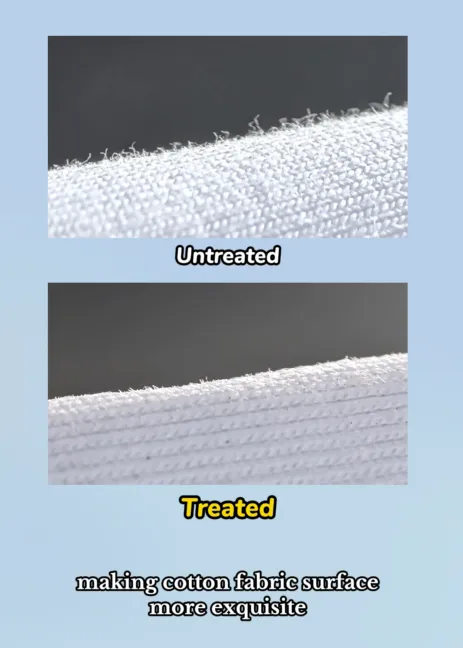
In addition to whiteness, after textile processing, there may be certain short fibers and fuzz on the surface of cotton fabrics.
These surface fibers will influence the smoothness and final appearance of fabrics.
Biological polishing is one of the important finishing methods for this problem.
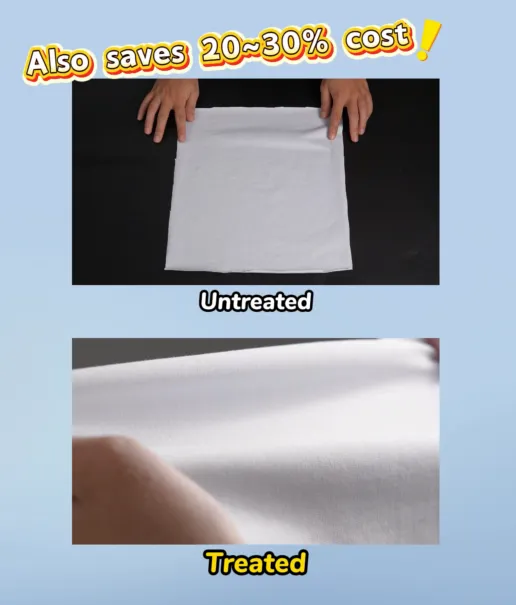
The treatment with biological polishing enzyme can improve partial fuzz state of cotton fabric surface, making the fabric surface smoother and cleaner, thereby enhancing the final appearance of the fabric.
In biological polishing, dyeing mills usually need to pay attention to:
- polishing effect
- smoothness of fabric surface
- process stability
- storage and transportation conditions of enzyme
- matching degree with existing pretreatment process
Therefore, when choosing a biological polishing enzyme, they should not merely focus on the product name but also make tests in combination with the factory’s equipment and process conditions.
What Aspects Should Dyeing Mills Pay Attention to When Choosing Bleaching and Bio-Polishing Products?
Firstly, figure out which production link needs to be solved
Although branqueamento, deoxygenizing, whitening and bio-polishing all belong to pretreatment process, their problems to be solved are different.
If the main issue is the stability during bleaching process, it needs to pay special attention to bleaching stabilizer.
If there is residual oxidizing agent after bleaching, it needs to pay attention to deoxygenizing product.
If there are many fuzz on fabric surface and it needs to improve smoothness of fabrics surface, it need to pay attention to bio-polishing enzyme.
Determining the problem and then choosing product is more reasonable for choosing a product.
Secondly, pay attention to the product form
Biological polishing enzymes can have different product forms.
For dyeing mills, product form not only affects the storage and transportation, but also influences the using method on site.
For example, powder product usually requires management of dissolution, feeding and production equipment and liquid products require more attention to transportation and storage conditions.
Therefore, when choosing products, purchasing staff needs to take the product form into account in actual production conditions.
Thirdly, pay attention to the subsequent process after bleaching
After bleaching, fabrics often need to be processed by dyeing or other processing.
Thus, when choose a pretreatment product, we should not only focus on the effect of current process, but also consider the connection with next process.
Especially the residual oxidizing agent after bleaching, if it is not controlled reasonably, it need further deoxygenizing process.
Fourthly, pay attention to the final whiteness and fabric appearance
For white and light-colored products, whiteness may be an indicator that customers pay close attention to.
For high-quality cotton fabrics, in addition to whiteness, the smoothness of fabric surface also affects the final visual effect.
Therefore, according to customer’s order requirements, bleaching, whitening and biological polishing can be respectively incorporated into the overall pretreatment plan.
BLUELAKECHEM Bleaching and Bio-polishing Series: From Stabilizing Bleaching to Improving Fabric Surface
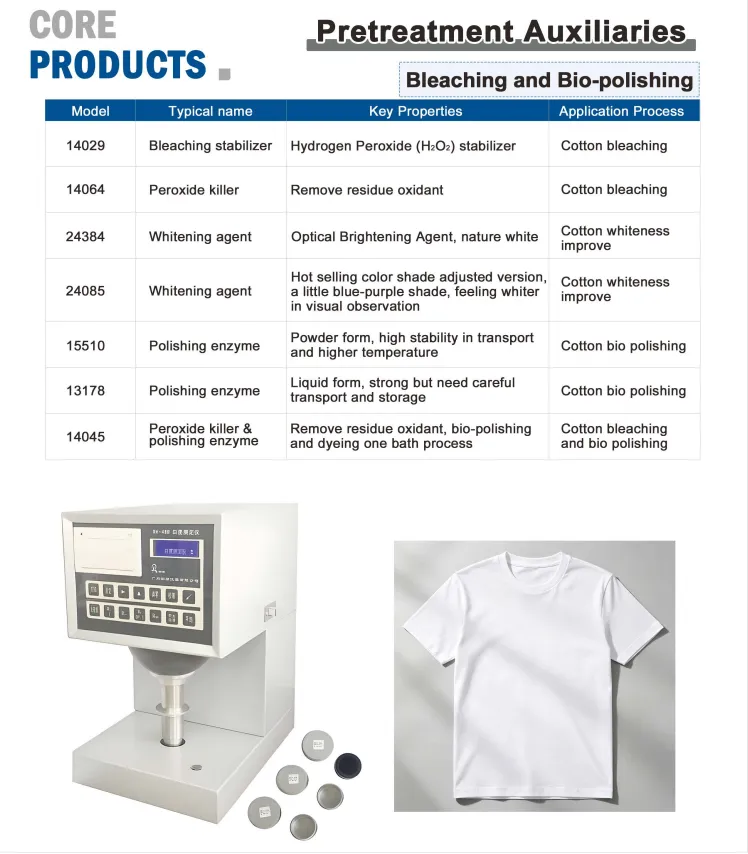
BLUELAKECHEM bleaching and bio-polishing series include bleaching stabilizer, deoxidizing agent, whitening agent, bio-polishing enzyme and composite type products, which can be selected according to different requirements for pretreatment process of cotton knitted fabrics.
At present, this series include:
14029, 14064, 24384, 24085, 15510, 13178 e 14045.
The different items are targeted at different production processes. Therefore, when actually selecting a product, it should be chosen according to the final requirements of fabrics and process.
How to Choose a Suitable Bleaching and Bio-polishing Product according to Dyeing Mill’s Requirement?
For purchasing staff and dyeing mill engineers, they can have a preliminary screening based on the main production demands:
| Main Production Demands | Product Item No. | Important Function |
| Hydrogen peroxide bleaching of cotton fabrics | 14029 | Stabilize the bleaching |
| Remove residual oxidizing agent after bleaching | 14064 | Remove oxygen |
| Improve whiteness of cotton fabrics | 24384 | Optical whitening |
| Adjust whiteness and visual color shade | 24085 | Whitening, adjust blue-purple color shade |
| Bio-polishing of cotton fabrics, prefer powder product | 15510 | Powder bio-polishing enzyme |
| Bio-polishing of cotton fabrics, prefer liquid product | 13178 | Liquid bio-polishing enzyme |
| After bleaching, combine deoxygenizing and bio-polishing | 14045 | Deoxygenizing + Bio-polishing |
In actual production, it is not recommended to make a choice merely based on the product item number or purchase price.
The more reasonable method is to firstly determine that:
What is the fabric → What is the current process → What is the main problem → What is customer’s final demand
And then select the corresponding product to test on fabric sample and process.
14029: Hydrogen Peroxide Bleaching Stabilizer
The typical name of 14029 is bleaching stabilizer which is mainly used for the bleaching of cotton fabrics.
Its core function is used as the stabilizer of hydrogen peroxide bleaching system.
For dyeing mills using hydrogen peroxide to bleach cotton fabrics, the system stability of bleaching process is an important issue.
Therefore, if the factory is now mainly concerned about the stability of hydrogen peroxide during the bleaching process of cotton fabrics, you can test 14029 in your own process.
14064: Treatment of Residual Oxidizing Agent after Bleaching
The typical name of 14064 is deoxygenizing enzyme which is mainly used in the bleaching of cotton fabrics.
Its core function is to remove residual oxidizing agent after bleaching.
Therefore, different from 14029, 14064 mainly corresponds to the treatment after bleaching.
For cotton fabrics to be dyed after bleached, it can be evaluated whether they need additional deoxygenizing step according to actual production process. And you can test the compatibility of 14064 with current process.
24384: Optical Whitening Agent to Improve the Whiteness of Cotton Fabrics
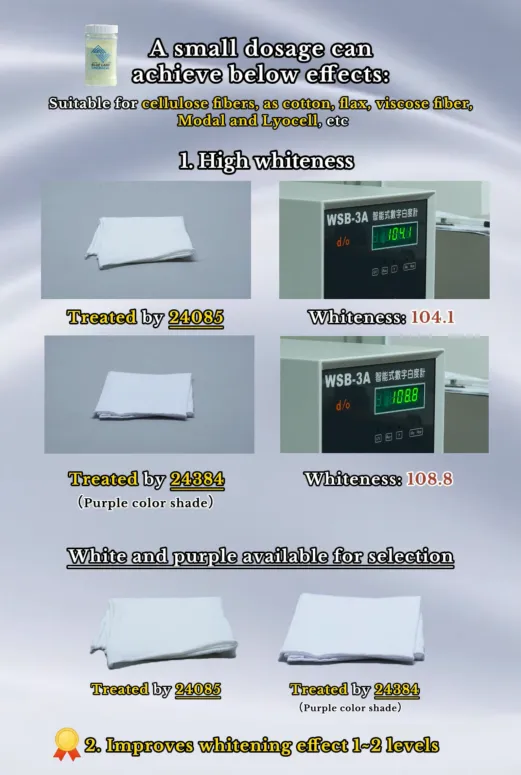
24384 belongs to whitening agent, which is mainly applied to improve the whiteness of cotton fabrics.
The product information shows that it is optical whitening agent, which is used to improve the visual whiteness of fabrics.
For white cotton fabrics and products with requirements for whiteness, customers can make test on sample fabric according to own standard.
It should be noted that whitening agent and bleaching stabilizer are to solve different problems:
Bleaching is to improve the base color of fabrics. And whitening agent is to further improve the final visual whiteness.
Thus, they are not simply the products with same function.
24085: Whitening Agent Aimed at Adjusting Color Shade
24085 also belongs to whitening agent, which is mainly used to improve whiteness of cotton fabrics.
Comparing with 24384, 24085 is particularly emphasized its function of adjusting color shade. It has slight blue-purple shade. It can appear whiter effect visually.
Therefore, for cotton fabrics with specific requirements for final whiteness and visual color shade, 24085 can be tested according to customer’s standard.
Especially for white products, the final visual effect is related to not only value of whiteness, but also the appearing color shade.
Therefore, 24085 can be a product choice for cotton fabrics to improve whiteness and adjust color shade.
15510: Powder Bio-polishing Enzyme
15510 is enzima de biopolimento, which is mainly applied in the polishing of cotton fabrics.
It is powder. It has good transportation stability. And it is also suitable for high temperature.
For dyeing mills need bio-polishing of cotton fabrics and pay attention to the stability of product transportation and storage, they can test it in their existing equipment and process conditions.
The powder form also gives it its own characteristics in terms of transportation and storage management.
13178: Liquid Bio-polishing Enzyme
13178 is also bio-polishing enzyme for cotton fabrics, but it is líquido.
Product information shows that it has stronger treating ability and its transportation and storage needs more caution.
Therefore, one of the main differences between 13178 and 15510 is the product form.
If the dyeing mill’s current production system is more suitable for liquid enzyme, 13178 can be tested in actual process. If the dyeing mill pay more attention to the transportation and storage stability of powder product, it can have further comparison with 15510.
14045: Composite Type Product of Deoxygenizing and Bio-polishing
14045 is a distinctive product in this series, and its typical name is: Deoxygenizing and Bio-polishing Enzyme.
The product information shows that it can achieve removing residual oxidizing agent and bio-polishing in same process, which is mainly applied in the bleaching and bio-polishing of cotton fabrics.
For dyeing mills that want to simplify process and reduce using different products, they can test 14045 according to their own production conditions.
However, whether the process optimization can be truly achieved needs to be verified based on the fabric, equipment and actual process.
From Single Product to Complete Cotton Fabric Pretreatment Solution
For dyeing mills, bleaching and bio-polishing are not two totally separate links.
A complete cotton fabric pretreatment system can respectively combine bleaching stabilization, deoxygenizing, whiteness improvement and biological polishing according to actual production requirements.
For example:
Bleaching stage
Pay close attention to the stability of bleaching system and choose the corresponding bleaching stabilizer.
After bleaching
If there is residual oxidizing agent, it can make deoxygenizing to create more suitable condition for subsequent dyeing.
White products
If customers have higher requirements for final visual whiteness, they can further choose corresponding whitening agent.
Improvement of surface quality
If there is much fuzz on fabric surface, you can choose a bio-polishing enzyme according to process condition.
Hope to reduce process steps
For specific production condition, you can further test the composite type product of deoxygenizing and bio-polishing.
Therefore, a truly reasonable product selection does not mean having all customers use the same auxiliary, but rather establishing a more compatible pretreatment solution based on actual process.
BLUELAKECHEM: Provide Bleaching and Bio-polishing Solution to Global Textile Enterprises
BLUELAKECHEM has been focusing on research, development, production and application of auxiliares químicos têxteis. We provide textile dyeing and finishing auxiliaries and application support for overseas dyeing mills, textile production enterprises and textile chemicals traders.
In the field of pretreatment, BLUELAKECHEM has established a product system including bleaching stabilizers, deoxygenizing agent, whitening agent, bio-polishing enzyme and composite type pretreatment products.
At present, our bleaching and bio-polishing series include:
14029, 14064, 24384, 24085, 15510, 13178 and 14045
Different products respectively correspond to different production demands, such as bleaching stability, residual oxidizing agent treatment, whiteness improvement, biological polishing, and the combination of deoxygenizing and bio-polishing.
If your cotton fabric production process has problems such as insufficient bleaching stability, residual oxidizing agent, insufficient whiteness, the need to adjust visual color shade, too many fuzz on fabric surface, or you wish to improve bio–polishing process, you can select the corresponding products for testing based on actual fabric, equipment and production process.BLUELAKECHEM can provide sample for testing and product application support according to customers’ fabrics, production equipment, existing process and requirements of final products. By actual test, we can help dyeing mills to determine a more suitable pretreatment solution for their own production conditions.