

In modern textile printing and dyeing industry, the competition in product quality is no longer confined to the dyes themselves. As the fabric types constantly enrich, dyeing process becomes increasingly complicated, and international brands constantly raise their requirements for color consistency and quality stability, how to maintain the stability of dyeing bath, reduce color spots and color stains, and enhance the right first time of dyeing has become a common challenge faced by many dyeing mills.
Whether it is polyester, wool, nylon, cellulose fibers or various kinds of blended fabrics, a stable dyeing bath condition is required during the dyeing process. If the dye is unevenly dispersed, coagulated or settles, it not only easily cause dyeing defect, color spots and color stains, but also increases the rework rate and production cost. Therefore, there are more and more textile enterprises are starting to attach importance to the significant role of high-concentration dispersing powder in dyeing process.
Why Does Dyeing Stability Determine the Final Product Quality?
For dyeing mills, nhuộm is not just to give fabrics colors, but more importantly, it is to ensure uniform and consistent colors and enable stable and repeated production.
In actual production, due to temperature changes, water quality fluctuations, concentration of electrolyte and the characteristics of dyes themselves, dye particles are prone to aggregation or deposition. When dyes cannot be dispersed evenly, they will affect their diffusion speed on fibers, resulting in local dye concentrations being too high or too low, thereby forming color spots, color stains, dyeing defect and color differences.
These problems not only influence the product appearance, but will also increase the risk of color repairing, rework and even scrapping. That will directly influence enterprises’ production efficiency and customer satisfaction.
Thus, maintaining the long-term stability of dyeing bath has become an important link for modern dyeing mills to improve product quality.
What Kind of Dyeing Challenges Are Modern Dyeing Mills Facing?
With the continuous growth in demand for high-quality textiles, dyeing mills not only need to meet the dyeing requirements of different fibers, but also need to take into account production efficiency, environmental protection regulations and cost control.
However, in actual production, many enterprises still encounter the following problems:
- Insufficient dispersion of dyes can easily lead to color spots and color stains.
- Stability of dyeing bath is not enough. There are differences in color shade among different batches
- In the condition of high temperature and high electrolyte, the dispersing performance decreases.
- The metal ions in hard water influence the stability of dyes.
- Too many foams influence circulation and equipment operation.
- Frequent switching among multiple auxiliaries makes it difficult to guarantee the process stability.
With the continuous acceleration of production pace, enterprises increasingly need a general-purpose dispersing agent that can adapt to different process conditions and always maintain stable performance.
Các yêu cầu cốt lõi mà các quan điểm khác nhau tập trung vào thực ra là giống nhau
In modern textile enterprises, although different positions undertake different responsibilities, the ultimate goal is to improve product quality and reduce comprehensive cost. Enterprise managers hope to reduce rework, increase rate of equipment utilization and shorten the delivery cycle. Purchasing department focuses more on the stability of product quality, usage cost, supply capacity and compatibility with existing processes. Process engineers pay more attention to the stability of dispersing agent under different temperatures, water qualities and electrolyte condition, hoping to reduce color spots, color stains and process abnormalities and improve the success rate of one-time dyeing by maintaining the even dispersing of dyeing solution. A high-concentration dispersing powder with stable performance and wide application range can not only meet the actual needs of different positions, but also help enterprises to establish a more efficient and stable dyeing system.
Why Does High-concentration Dispersing Powder Become More and More Popular?
Comparing with traditional dispersing agent, high-concentration dispersing powder has higher active ingredient content, which is not only convenient for transportation and storage, but also can reduce the cost of packaging and logistics.
More importantly, it can serve as a protective colloid during the dyeing process and effectively coat the dye particles, so as to keep them in a uniformly dispersed state at all times and prevent coagulation and sedimentation of dyes, and thus maintaining the stability of the dyeing bath.
A stable dyeing bath means a more even dyeing effect, a higher right first time of dyeing and more consistent product quality. This is also an important reason why more and more modern dyeing mills choose high-concentration dispersing powder.
Can Be Widely Applied in the Dyeing Processing of Various Kinds of Fabrics
For comprehensive textile enterprises, a dispersing agent that can be applied in different fibers and dyeing processes can effectively reduce the types of producs and formula adjustments, and enhance production flexibility. With the excellent dispersing performance, good process stability and wide compatibility, high-concentration dispersing powder can be applied in the dyeing process for various kinds of natural fibers, chemical fibers and their blends. In different processing condition, it can keep stable dispersing effect and provide fabrics with more even and consistent dyeing quality.
Still Keeps Stable in Complicated Process Condition
Modern dyeing processes usually need to be carried out in high temperature, different acid and alkali conditions, and high electrolyte concentrations.
If the stability of dispersing agent is insufficient, it will easily lose its dispersing effect, which will cause the dyes to re-aggregate and affect the whole dyeing bath system.
Therefore, an excellent high-concentration dispersing agent not only needs to have excellent dispersing ability, but can also resistant to hard water, acid, alkali and various electrolytes. It can still keep good stability in different process conditions, so as to provide reliable guarantees for continuous and high-efficiency production.
The Design of Low Foaming Improves Production Efficiency
With the popularization of automated dyeing equipment, low-foaming performance has become one of the important indicators of dispersing agent.
Excessive foams not only affect the liquid circulation but may also reduce the operational efficiency of equipment and increase the dosage of defoaming agent and the cleaning cost.
Low foaming and high-concentration dispersing powder can reduce foams, make the dyeing bath circulation smoother, improve the rate of equipment utilization, and provide a more stable process condition for continuous production.
Recommend Solution: 45191 High Concentration Dispersing Powder
Aiming at modern dyeing mills’ demands for the stability, dispersing performance and process stability of the dyeing solution, 45191 High Concentration Dispersing Powder offers a more efficient and stable solution.
According to product technology data (TDS), 45191 is mainly composed of sulfonate derivatives. It is suitable for disperse dyes, reactive dyes and acid dyes, which can effectively improve the stability of dyeing bath, prevent coagulation of dyes and improve the dispersity and solubility of dyes, so as to improve leveling effect. As a general-purpose and low-foaming dispersing agent, it is suitable for the dyeing of polyester, wool, nylon, cellulose fiber and their blends. It is highly stable in hard water, acid, alkali and electrolyte.
The main advantages of product include:
- Easily soluble in water. Low foaming. Convenient for using. Suitable for modern automated dyeing equipment.
- Can be used as a protective colloid in dyeing process to keep dyeing solution stable, reduce dyeing defect, such as color spots and color stains, etc.
- Excellent dispersing performance. Can improve the dispersing and solubilizing effect of dyes and improve leveling performance.
- Stable in hard water, acid, alkali and electrolyte. Can be applied in complicated process condition.
- Can be widely applied in the dyeing of various kinds of fabrics. Not influences the color shade of fabrics. No unpleasant odor. Can meet the application requirements of different fabrics and processes.
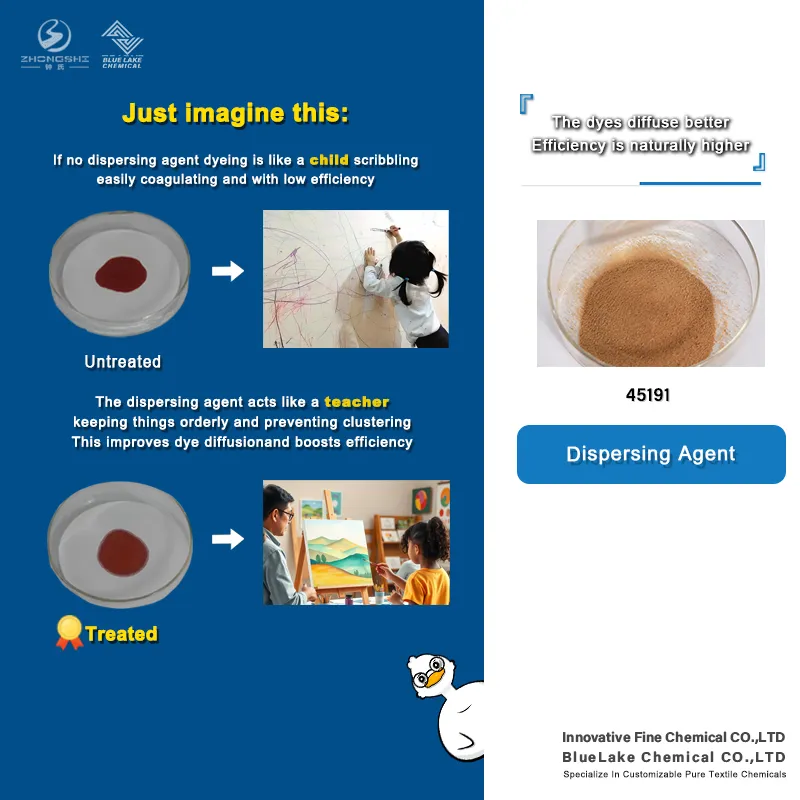
For textile enterprises who hope to improve dyeing quality, reduce rework and optimize production efficiency, 45191 can provide more stable and higher-efficiency dispersing solution to the whole dyeing process.
Giới thiệu về BLUELAKECHEM
BLUELAKECHEM has been focusing on research, development, production and technical service of phụ gia dệt. Các sản phẩm của chúng tôi bao gồm chất trợ xử lý trước, chất trợ nhuộm, chức năng chất hoàn thiện, Dầu silicone Và chất làm mềm silicon, which provides the global dyeing mills, textile mills and hóa chất dệt may distributors with perfect textile chemicals solution. With rich industry experiences, stable product quality and professional technical support, BLUELAKECHEM has continuously provided high-performance textile auxiliaries for global customers, to help enterprises to optimize dyeing and finishing process, improve product quality, decrease comprehensive production cost and promote the textile industry to develop towards a higher-efficiency, more environmentally-friendly and sustainable direction.